CubeSolver - Around the Cube
Before diving into solving a Rubik's cube, it's good to understand how this object works.
The Cube Universe
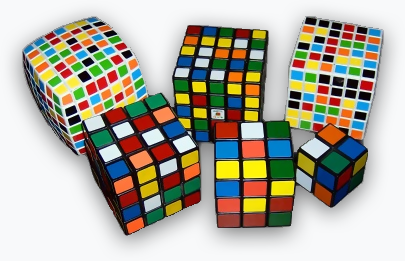
There are other sizes of Rubik's Cubes!
Cubes ranging from 2x2x2 to 7x7x7 are commonly found.
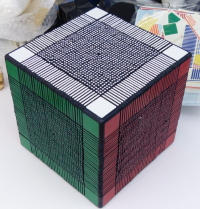
The world's largest Rubik's Cube has 33 layers! (33x33x33) Cubes of this size are rare, difficult to create, and even harder to solve.
There are many Rubik's Cube competitions.
Most of them are speed competitions. Speedcubers try to achieve the best possible performances across a wide variety of events.
The most common one involves solving a 3x3x3 cube as quickly as possible, but there are also competitions for one-handed solving, blindfolded solving, and for cubes of all sizes.
Some events are not speed events but aim to solve a Rubik's Cube in as few moves as possible!
The world record for 3x3x3 solving by a human is 4.22 seconds.
There are many robots capable of solving Rubik's Cubes.
And the fastest among them are far more performant than humans: the world record for 3x3x3 solving by a robot is 0.38 seconds.
While this is a speed solving record, it should also be noted that robots of all types exist that can solve Rubik's Cubes.
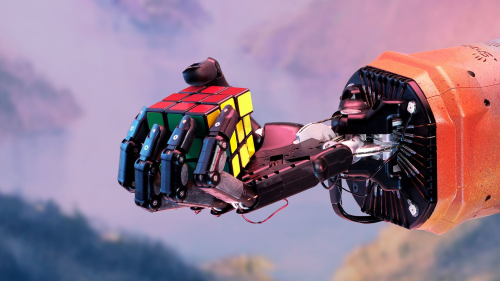
For example, researchers at OpenAI have developed a robotic hand capable of solving the cube.
Other robots aim to solve large cubes. One example is MultiCuber 999, which solved a 9x9x9 cube in 34 minutes. This robot has an original mechanism: a platform moves vertically to rotate the cube at any point.
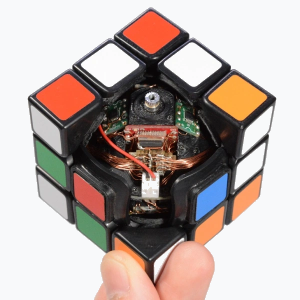
There is also a Rubik's Cube that can solve itself. The entire miniaturized mechanism fits inside the cube:
There are about 43,000,000,000,000,000,000 possible configurations of the cube (4.3 × 10^19).
Yet, regardless of the starting configuration, the cube can always be solved in 21 moves or fewer.
If you covered the Earth with standard Rubik's Cubes, each in a different configuration, you could cover it about six stories high. There would then be ten times more Rubik's Cubes than grains of sand on Earth.
If you visualized 1000 different combinations every second, it would take 136 billion years to go through them all.
This combinatorics is fascinating, and it's why mathematicians have always been interested in this object.
Rubik's Cubes are not the only 3D puzzles to generate interest!
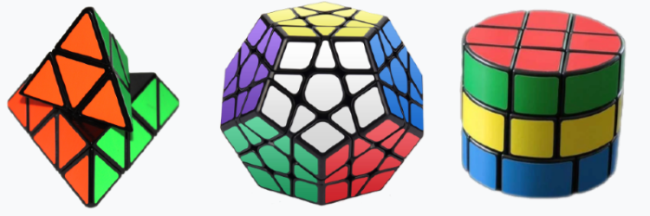
Indeed, while this puzzle is originally cubic, many puzzles have other shapes. Examples include the Pyraminx, the Megaminx, or the Rubik's Barrel:
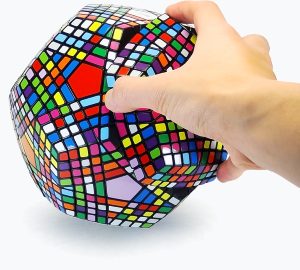
Again, it is possible to create larger puzzles based on these shapes. Here's what a Petaminx looks like:
Structure
A 3x3x3 Rubik's Cube has six faces, each with nine colored stickers.
Beyond this simple definition, we can observe that the cube is made up of 26 pieces:
- 6 centers
- 8 corners
- 12 edges
To see this, we can simply look at a disassembled cube:
<img src="/images/cubesolver/cube-démonté.jpg" alt="A disassembled Rubik's Cube" style="max-width: 400px; width: 100%; height: auto;" />The centers (attached to the core) each have one color. The edges (on the left) have two colors. The corners (on the right) have three colors.
Thinking in terms of piece positioning is essential for solving a Rubik's Cube, since solving the cube means bringing each piece to its final position.