CubeSolver - Notation Conventions
To study the solving of a Rubik's cube, we must define a set of notations and concepts.
The following elements will be presented in this article:
- The cube representation used on this site.
- The face and move notations used by speedcubers.
- The definition of piece orientations.
The definition of piece orientations is quite technical. I only recommend reading it for readers wishing to gain a thorough understanding of the solving methods and cube integrity verification.
Cube Representation
Several cubes may be presented on this site. When that happens, a flattened net will be used:
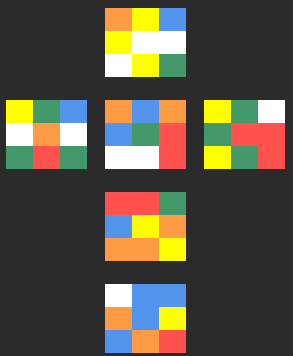
Face Notation
The commonly used notation for Rubik's Cube faces is as follows:
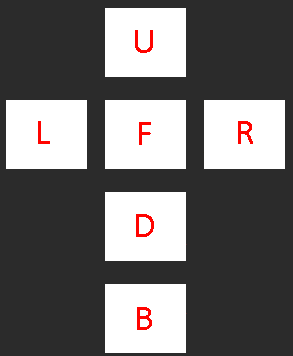
- U for the top face (UP)
- D for the bottom face (DOWN)
- F for the front face (FRONT)
- B for the back face (BACK)
- L for the left face (LEFT)
- R for the right face (RIGHT)
Move Notation
There are a total of 18 possible moves on a Rubik's cube, considering double moves but not slice moves. (A slice rotation is equivalent to rotating both adjacent faces).
For each face, we have:
- The 90° clockwise move.
- The 90° counter-clockwise move.
- The 180° move. (the half-turn of a face)
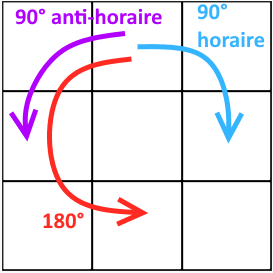
We denote [Move] for a counter-clockwise move, and [Move]2 for a 180° move.
Our 18 moves are therefore: U, U', U2, D, D', D2, F, F', F2, B, B', B2, L, L', L2, R, R', R2.
Orientation Definitions
On a Rubik's cube, the word "orientation" can refer to several things.
Cube Orientation
The cube's orientation is the position of the color centers on the cube.
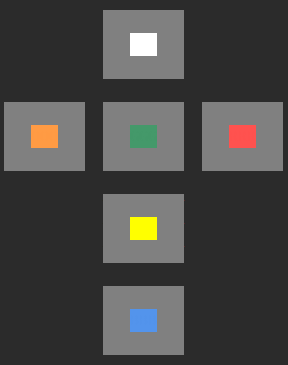
Here, the white center is on the top face, the green center is on the front face, etc. This is the orientation used throughout the site.
Edge Orientation
An edge is said to be correctly oriented if it is possible to bring it to its final position without using the U or D faces.
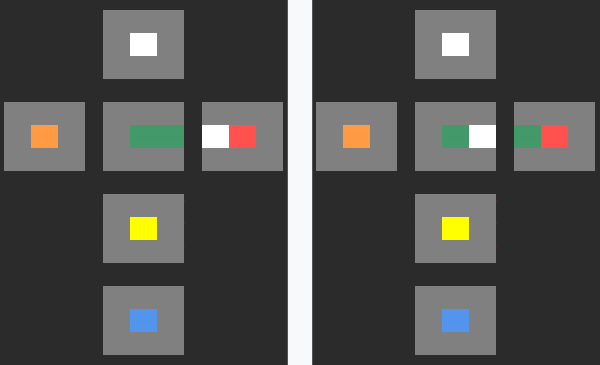
In the left example, the white-green edge is correctly oriented, since it can be solved with the move F'. (Counter-clockwise move of the front face)
In the right example, the white-green edge is incorrectly oriented, since the sequence "R, U" is needed to solve it. (and therefore the U face is used)
Corner Orientation
A corner is said to be correctly oriented if its L / R color is located on the L / R side.
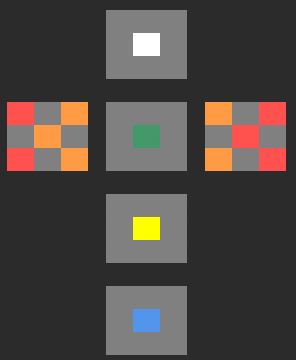
In the example above, only the L / R colors (Red and Orange) of the corners are shown, for readability. Here, all corners are correctly oriented, since all L / R colors are present on the L / R faces.
Going Further
Corner orientation can be considered more finely than "correctly oriented" or "incorrectly oriented". We can consider the number of clockwise rotations from the correct orientation.
I exceptionally use a 3D cube diagram to explain this point; I think it's clearer.
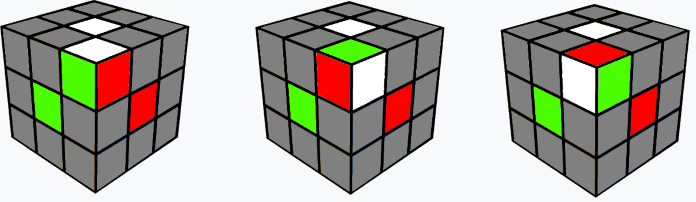
This definition of corner orientation will be used during cube integrity verification (Vision section).